
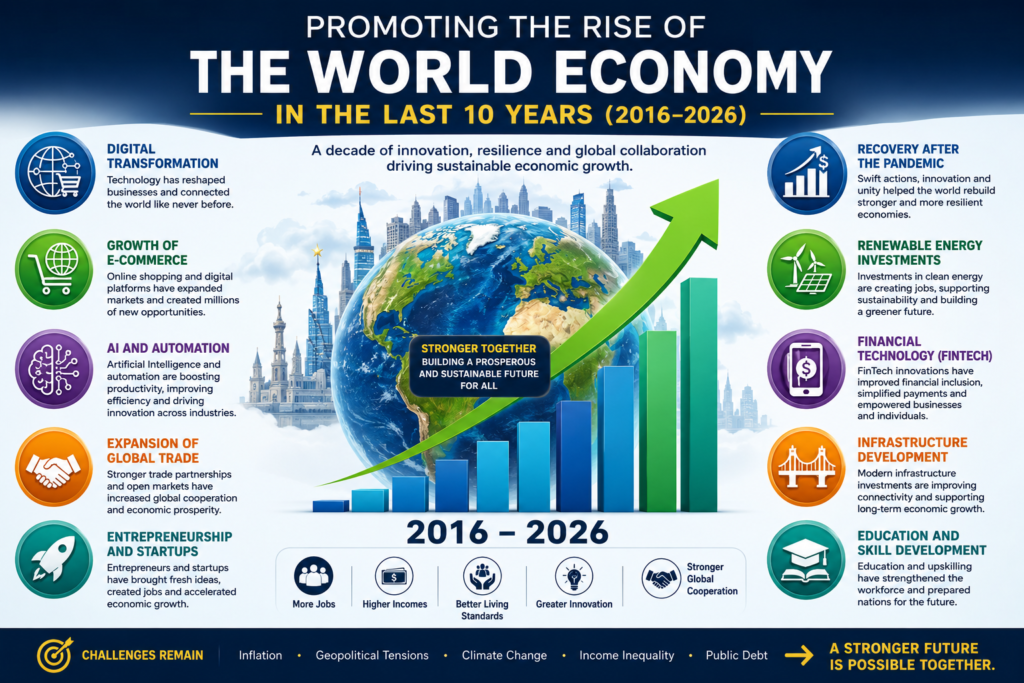
The rise of the world economy over the last 10 years has been driven by technological innovation, digital transformation, international trade, entrepreneurship, and economic recovery after global challenges. From 2016 to 2026, countries around the world have experienced major changes in how businesses operate, how people work, and how governments support economic growth.
While the decade included difficult events such as the COVID-19 pandemic, inflation, and geopolitical tensions, the global economy has shown remarkable resilience. New industries have emerged, millions of businesses have gone digital, and investments in renewable energy and artificial intelligence have opened new opportunities for long-term growth.
In this article, we explore the major factors that have promoted the rise of the world economy over the past decade and what they mean for the future.
Understanding the Rise of the World Economy
The rise of the world economy refers to the overall increase in global economic activity, including higher production, stronger international trade, improved technology, rising investments, and better employment opportunities.
Economic growth is commonly measured by indicators such as Gross Domestic Product (GDP), productivity, trade volumes, business expansion, and income levels. Although growth has not been equal across all countries, the world economy has continued to evolve through innovation and globalization.
1. Digital Transformation Has Changed Everything
One of the biggest drivers behind the rise of the world economy has been rapid digital transformation.
Businesses have adopted digital technologies to improve efficiency, reduce costs, and reach customers worldwide. Cloud computing, e-commerce, online banking, remote work, and digital marketing have become essential parts of modern business.
Small businesses now have access to global markets through online platforms, while consumers enjoy faster and more convenient services.
Key benefits include:
- Increased business productivity
- Lower operating costs
- Global customer reach
- Better communication
- Faster financial transactions
Digital technology continues to create new opportunities for entrepreneurs and investors around the world.
2. Growth of E-Commerce
Online shopping has experienced enormous growth over the past decade.
Consumers now purchase everything from groceries to electronics through digital platforms. Businesses of every size have established online stores, making products available across international markets.
The growth of e-commerce has benefited:
- Retail businesses
- Logistics companies
- Digital payment providers
- Software developers
- Marketing agencies
This expansion has created millions of new jobs while increasing global trade.
3. Artificial Intelligence and Automation
Artificial Intelligence (AI) has become one of the most important contributors to the rise of the world economy.
AI helps businesses:
- Automate repetitive tasks
- Improve customer service
- Analyze large amounts of data
- Reduce operational costs
- Increase productivity
Industries such as healthcare, education, agriculture, manufacturing, transportation, and finance now rely heavily on AI-powered solutions.
Automation allows companies to produce more goods and services with greater efficiency, contributing to stronger economic growth.
4. Expansion of Global Trade
International trade has remained one of the strongest foundations of economic growth.
Countries export products and services while importing resources they need from other nations. Trade agreements have helped reduce barriers and encourage investment between countries.
Benefits of global trade include:
- Access to larger markets
- Lower prices for consumers
- More business opportunities
- Increased foreign investment
- Job creation
Although trade has faced challenges from political tensions and supply chain disruptions, it continues to play a major role in the global economy.
5. Entrepreneurship and Small Businesses
Entrepreneurship has flourished during the past decade.
Millions of people have started businesses using online platforms, social media, and digital payment systems. The startup ecosystem has grown rapidly, particularly in technology, finance, education, agriculture, and health.
Governments and investors have supported entrepreneurs through funding programs, innovation centers, and business development initiatives.
Small and medium-sized enterprises (SMEs) now contribute significantly to employment and national economic growth.
6. Recovery After the COVID-19 Pandemic
The COVID-19 pandemic caused one of the biggest economic disruptions in modern history.
Many businesses closed temporarily, unemployment increased, and international travel nearly stopped.
However, countries responded with:
- Economic stimulus packages
- Business support programs
- Vaccination campaigns
- Infrastructure investments
- Digital transformation initiatives
As economies reopened, consumer spending increased, businesses resumed operations, and employment gradually recovered.
The recovery demonstrated the resilience of the global economy.
7. Renewable Energy Investments
Clean energy has become an important engine of economic development.
Countries are investing heavily in:
- Solar energy
- Wind power
- Electric vehicles
- Battery technology
- Green infrastructure
These investments create new industries while reducing dependence on fossil fuels.
Renewable energy projects generate employment opportunities for engineers, technicians, manufacturers, and construction workers.
Green investment is expected to remain one of the strongest contributors to future economic growth.
8. Financial Technology (FinTech)
Financial technology has transformed how people save, borrow, invest, and make payments.
Mobile banking, digital wallets, online lending platforms, and cryptocurrency technologies have expanded financial access for millions of people.
FinTech has helped businesses by:
- Simplifying payments
- Reducing banking costs
- Improving financial inclusion
- Increasing investment opportunities
Small businesses especially benefit from easier access to financial services.
9. Infrastructure Development
Governments have invested billions of dollars in infrastructure over the last decade.
Major investments include:
- Roads
- Airports
- Railways
- Ports
- Internet infrastructure
- Energy systems
Infrastructure projects stimulate economic activity by improving transportation, reducing costs, and attracting private investment.
Better infrastructure also supports tourism, manufacturing, and international trade.
10. Education and Skill Development
Education has become increasingly important in supporting economic growth.
Online learning platforms have made quality education available to millions of people worldwide.
Workers continue learning skills in:
- Programming
- Digital marketing
- Data analysis
- Artificial Intelligence
- Cybersecurity
- Business management
A skilled workforce improves productivity, innovation, and competitiveness.
Challenges Facing the World Economy
Although the rise of the world economy has been impressive, several challenges remain.
Inflation
Higher prices reduce purchasing power and increase living costs for families and businesses.
Geopolitical Conflicts
International conflicts can disrupt supply chains, increase energy prices, and reduce investor confidence.
Climate Change
Extreme weather events affect agriculture, infrastructure, and global production.
Public Debt
Many countries accumulated large debts during the pandemic, creating future financial challenges.
Income Inequality
Economic growth has not benefited everyone equally, leaving many communities behind.
Addressing these issues will be essential for sustainable long-term growth.
Future Outlook
The future of the rise of the world economy appears promising despite current uncertainties.
Several sectors are expected to lead future growth:
- Artificial Intelligence
- Renewable energy
- Robotics
- Biotechnology
- Space technology
- Digital finance
- Green manufacturing
- Smart agriculture
Businesses that embrace innovation and sustainability will likely achieve stronger long-term success.
Governments are also expected to continue investing in infrastructure, education, healthcare, and clean energy to strengthen economic resilience.
Why Economic Growth Matters
A growing economy benefits individuals, businesses, and governments in many ways.
Economic growth can lead to:
- Higher employment
- Better wages
- Increased investment
- Improved healthcare
- Better education
- Higher living standards
- Stronger public services
- Greater innovation
When managed responsibly, economic growth improves quality of life and creates opportunities for future generations.
Conclusion
The rise of the world economy over the last 10 years has been shaped by innovation, digital technology, entrepreneurship, global trade, renewable energy, and financial modernization. Despite major disruptions such as the COVID-19 pandemic and ongoing economic challenges, the global economy has demonstrated resilience and adaptability.
As technology continues to evolve and countries invest in sustainable development, the world economy is expected to continue growing. Businesses, governments, and individuals who embrace innovation, education, and responsible economic policies will be best positioned to benefit from future opportunities.
Understanding the factors behind the rise of the world economy helps individuals and organizations make informed decisions, prepare for changing markets, and contribute to a stronger and more prosperous global future.