
Introduction
Education has always been the foundation of human development. It shapes individuals, strengthens communities, and prepares future generations to face new challenges. Although the goal of education has remained the same—to gain knowledge and develop skills—the methods of teaching and learning have changed dramatically over the years.
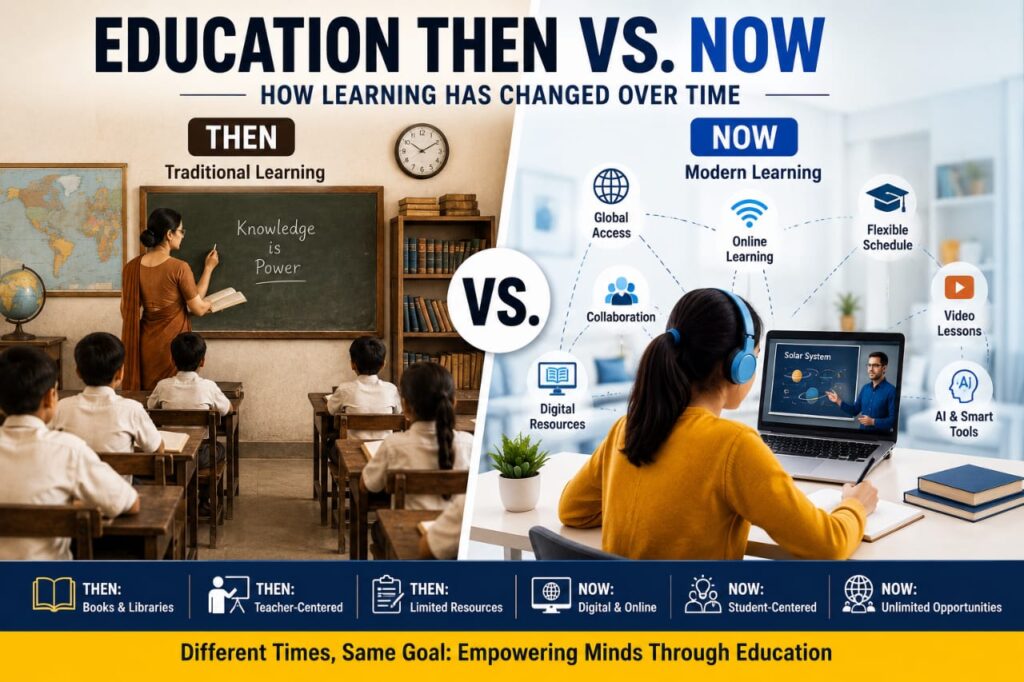
In the past, education relied heavily on books, teachers, and traditional classrooms. Today, technology has transformed education into a more flexible, interactive, and accessible experience. Students can now learn from anywhere in the world using smartphones, laptops, and online learning platforms.
This article compares education in the past and education today, highlighting the major differences, advantages, challenges, and what the future of learning may look like.
1. Learning Environment
Years ago, classrooms were simple. Students sat in rows, listened carefully to the teacher, copied notes from the blackboard, and studied mainly from printed textbooks. Libraries were the primary source of information, and students often spent hours searching for books to complete assignments.
Today, classrooms are more interactive. Many schools use digital whiteboards, projectors, tablets, and computers. Online classes have also become common, allowing students to learn from home or any location with an internet connection.
Technology has made education more flexible than ever before.
2. Access to Information
In the past, finding information required significant effort. Students visited libraries, searched through encyclopedias, and depended on teachers for explanations.
Today, millions of educational resources are available online. Students can watch video lessons, read articles, join virtual classes, and explore digital libraries within seconds.
Search engines, educational websites, and AI-powered assistants have made learning faster and more convenient.
3. Teaching Methods
Traditional education focused mainly on memorization. Teachers delivered lessons while students listened quietly and repeated information during exams.
Modern education encourages critical thinking, creativity, collaboration, and problem-solving. Students participate in discussions, group projects, presentations, and practical activities that help them understand concepts rather than simply memorize facts.
Learning has become more student-centered than teacher-centered.
4. The Role of Technology
Technology is one of the biggest differences between past and present education.
Students today use:
- Online learning platforms
- Educational videos
- Virtual classrooms
- AI learning tools
- Interactive quizzes
- Digital notebooks
- Educational mobile apps
Technology helps students learn at their own pace and access high-quality educational content from anywhere in the world.
5. Communication Between Teachers and Students
Years ago, communication happened only during school hours. If students needed help, they usually had to wait until the next class.
Today, communication is much easier. Teachers and students stay connected through email, messaging apps, online classrooms, and video meetings. Assignments, announcements, and feedback can be shared instantly.
This stronger communication improves the learning experience.
6. Learning Opportunities
In the past, educational opportunities depended largely on location. Students living in rural areas often had limited access to qualified teachers and learning materials.
Today, online education has reduced many of these barriers. Anyone with internet access can take courses from world-famous universities, attend webinars, and earn professional certificates without leaving home.
Education has become more inclusive and accessible.
7. Challenges of Modern Education
Although today’s education offers many advantages, it also comes with new challenges.
Some common challenges include:
- Too much screen time
- Internet distractions
- Misinformation online
- Academic dishonesty
- Digital inequality in some regions
Students must learn how to use technology responsibly and develop good study habits.
8. Skills Needed Today
The skills required today are different from those needed decades ago.
Modern students should develop:
- Digital literacy
- Communication skills
- Critical thinking
- Creativity
- Teamwork
- Problem-solving
- Adaptability
- Time management
These skills help prepare students for higher education, employment, and entrepreneurship.
9. The Importance of Lifelong Learning
Education no longer ends after graduation. Because technology and industries continue to evolve, people must continue learning throughout their lives.
Online courses, professional certifications, books, podcasts, and AI-powered learning tools make lifelong learning easier than ever.
Continuous learning helps people stay competitive in today’s rapidly changing world.
10. Looking Toward the Future
The future of education will continue to combine technology with traditional teaching. Artificial Intelligence, virtual reality, personalized learning, and digital collaboration will play even bigger roles in classrooms.
However, teachers will remain essential. Technology can provide information, but teachers inspire students, build character, encourage curiosity, and guide personal development.
The best education combines modern technology with experienced educators who help students think independently and responsibly.
Conclusion
Education has changed significantly over the years. Traditional education taught discipline, patience, and respect for teachers, while modern education offers flexibility, global access to knowledge, and innovative learning methods.
Both systems have valuable strengths. The traditional approach emphasized strong foundations and personal interaction, while today’s education provides endless opportunities through technology.
The future belongs to learners who embrace both worlds—respecting traditional values while making the best use of modern technology. By combining knowledge, creativity, discipline, and digital skills, students can prepare themselves for success in education, careers, and life.
As education continues to evolve, one truth remains unchanged: learning is one of the greatest investments anyone can make. Those who continue learning, adapting, and growing will always be better prepared for the opportunities and challenges of the future.