
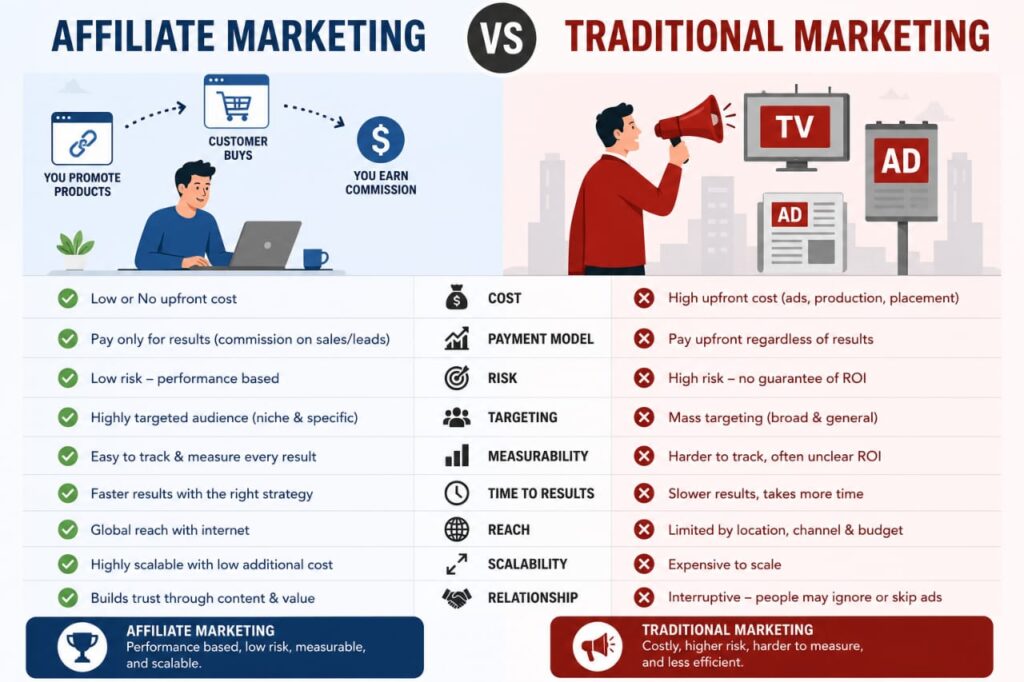
For decades, the path to entrepreneurship was set in stone: secure a physical storefront, buy inventory in bulk, hire staff, and open your doors to the local community. This is Traditional Commerce.
However, the explosive growth of the digital economy has turned this classic model on its head. Today, a new breed of entrepreneurs is generating massive revenue without ever touching a physical product, managing a warehouse, or signing a commercial lease. This is Affiliate Marketing.
If you are looking to launch a business in 2026, choosing between these two paths will determine your lifestyle, financial risk, and scaling potential. This comprehensive analysis breaks down the fundamental shifts, core differences, and financial realities of both business models.
Defining the Contenders
Before diving into the mechanics, let’s establish exactly what we are comparing.
- Traditional Commerce: This model relies on a physical presence—often referred to as a “Brick-and-Mortar” setup. It involves purchasing or manufacturing tangible goods, storing inventory, and selling directly to consumers through a physical shop, local market, or face-to-face network.
- Affiliate Marketing: This is a performance-based digital business model. Instead of creating a product, you partner with existing brands (merchants) to promote their products using unique tracking links. When a consumer buys through your link, you earn a percentage of the sale—a commission.
1. Upfront Capital and Financial Risk
The barrier to entry is the most striking differentiator between these two models.
Traditional Commerce: High Capital, High Risk
To start a traditional retail store, the financial runway required is substantial. You must account for upfront costs such as commercial security deposits, interior remodeling, point-of-sale (POS) systems, utility setups, and, most importantly, bulk inventory. If you buy $10,000 worth of stock and consumer trends shift, you are stuck with dead inventory and a net loss. The risk is completely absorbed by the business owner.
Affiliate Marketing: Near-Zero Overhead, Minimal Risk
Affiliate marketing completely eliminates the inventory burden. Your primary startup costs are purely digital: a domain name, reliable web hosting, an SEO tool, and potentially some design software or page builders. Because you only buy assets that keep your digital presence alive, your initial investment can be under $100. If a specific niche or product fails to convert, you simply switch your links to a different merchant without losing a dime on unsold goods.
2. Inventory and Supply Chain Management
How you handle products dictates how much time you spend on operations versus growth.
| Operational Factor | Traditional Commerce | Affiliate Marketing |
|---|---|---|
| Stock Management | Requires physical storage, auditing, and shelf rotation. | Completely handled by the merchant. |
| Shipping & Logistics | You pack, label, and ship every item (or pay a courier). | Zero involvement in fulfillment or delivery. |
| Customer Support | You manage returns, refunds, complaints, and damages. | The merchant’s customer service team handles it. |
In traditional commerce, supply chain disruptions—such as manufacturing delays or shipping bottlenecks—can halt your revenue entirely. In affiliate marketing, the entire supply chain is invisible to you. Your only job is to drive high-intent traffic to the offer.
3. Profit Margins and Revenue Control
While affiliate marketing wins on low overhead, traditional commerce offers a distinct advantage when it comes to financial control.
The Pricing Power of Traditional Retail
In a traditional store, you own the product, which means you control the pricing strategy. If you buy an item wholesale for $5, you can price it at $15, $20, or run strategic holiday discounts to manipulate your profit margins.
The Fixed Commission Structure of Affiliate Networks
As an affiliate, you are bound by the merchant’s terms. If an affiliate program pays a 10% commission on a $100 software package, you will make exactly $10 per sale. You cannot raise the price to make more money, nor can you personally offer an official site-wide discount. Your revenue is entirely dependent on your conversion volume and the Earning Per Click (EPC) metrics dictated by the program platform.
4. Scaling Capabilities and Audience Reach
Scaling a business means growing your revenue faster than your operating expenses.
[Traditional Retail] ──> Requires More Space + More Staff ──> High Linear Costs
[Affiliate Marketing] ──> Scaled Content + Global Web Traffic ──> Exponential Growth
Traditional Commerce is Geographically Bound
A physical store is constrained by local geography and foot traffic. To double your revenue, you usually have to double your costs: open a second location, hire more cashiers, and buy twice the inventory. Growth in traditional commerce is linear and expensive.
Affiliate Marketing is Boundless
A well-optimized affiliate website or content channel faces no geographical limits. An article written in your home office can attract thousands of targeted visitors simultaneously from New York, London, and Tokyo. Because digital infrastructure scales infinitely, your website can handle 1,000 or 100,000 visitors a day with virtually the same hosting costs. This allows for exponential, hands-off scaling.
5. Customer Relationship and Asset Value
Who actually owns the customer at the end of the day?
The Blind Spot of Affiliate Marketing: When you send a buyer to a merchant’s site via an affiliate link, the merchant wins the customer long-term. They get the customer’s email address, shipping details, and future brand loyalty. If that customer buys again six months later without clicking your link, you receive nothing.
In contrast, traditional commerce builds deep, local brand equity. You possess the direct relationship with your community. You capture their contact information, control their shopping experience, and build an asset—a local brand—that can eventually be valued and sold as a complete, functioning physical enterprise.
The Verdict: Which Path Should You Choose?
The choice between affiliate marketing and traditional commerce comes down to your available capital, your risk tolerance, and your long-term goals.
- Choose Affiliate Marketing if: You have limited starting capital, want to work from anywhere in the world, prefer focusing entirely on digital marketing and content creation, and want a business that can generate passive income without operational headaches.
- Choose Traditional Commerce if: You have solid investment capital, want absolute control over your pricing and product quality, enjoy direct face-to-face human interaction, and want to build a visible, tangible brand footprint within a specific community.
Ultimately, the modern digital landscape doesn’t strictly force you to choose one forever. Many successful entrepreneurs start in affiliate marketing to learn data tracking, SEO, and consumer psychology with low risk, and later use those profits to fund their own physical retail brands.